

People Get Ready
The end is nigh

This summer, as the climate crisis barks furiously at our door, it is interesting and instructive to examine the common ways in which humanity is looking at its approaching doom.
It strikes me that the ways in which most people think about the climate crisis can be broken down into three rough buckets. Which bucket you fall into is probably a decent predictor of whether you will decide to prepare for what’s coming in your neck of the woods, and whether you’ll be on the barricades when the climate revolution comes.
Let’s dig in.
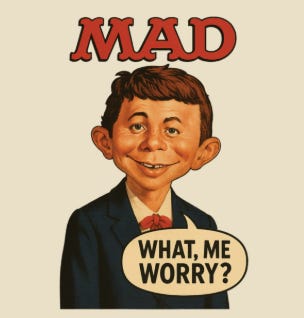
What, Me Worry?
Group 1.
Some folks aren’t worried. Some folks still don’t believe that the climate crisis is happening at all, although this number has decreased. These people do not see a crisis, and so have nothing to worry about. Also in the “what, me worry?” camp are the cohort who truly think that more CO2 in the atmosphere is going to be better for the plants, and that the heat waves going on across the globe are just spells of lovely sunny, summer weather.
The “what, me worry?” crew will not be preparing, because there is nothing to prepare for.
If and when the shit truly hits the fan where they live, they are likely to be “on the barricades,” but not in a constructively planned or effective way: they’ll feel massive, horrific betrayal. They might riot. It happens.
It Won’t Be That Bad
Group 2.
These are our fellow travellers who “believe” that the climate is changing and have some idea of what is coming. They’re concerned enough to listen to political messages, and perhaps even to vote for representatives who promise “green new deal” style policies. Yet this understanding is detached and impersonal on some level. This group of folks have taken the knowledge on board, then performed the requisite mental gymnastics to create a road map that does not include a path to their personal destruction.
These folks are sure that while something is going on, it really can’t be civilisation threatening, and anyway it’s all going to get sorted.
They might buy into the climate hopium peddled by politicians who continue to talk about net zero.
They may place their trust in what the redoubtable Jeff McFadden calls “renoobles.”
They may think that by recycling and turning off the water while they clean their teeth they are making a good deal of difference.
They may point to a personally lowered carbon footprint, and think that this summed over a largest number of people, is really enough to do the trick.
They send you information about the “new green economy” and think that Exxon and Shell and BP are telling the truth about the world saving powers of algae-based fuels.
This group is not worried enough to begin to prepare for what is coming. You may or may not be among them, but if you are, I envy your calm and sanguine headspace.
If and when the revolution comes, the response from this cohort is likely to be panic and thrashing. They’ll feel that they have been “doing enough” all along, and will be blindsided.
Doomers
Group 3.
This is the “climate woke” crew. They know collapse is coming. They were at the climate march in 2014. They post about global warming on their socials. They are paying attention and they are furious with the status quo. These are your friends who cannot look at a graph of future heat projections without focusing on the very highest, direst, reddest line on the chart.
This group has read a lot on the subject and can discuss the finer points of the current science. They don’t need to have Skeptical Science bookmarked - their knowledge is advanced. Their arguments are marshalled. They don’t “believe.” They KNOW.
Oddly, many of these people are also not preparing personally, or doing political work, or organising, or mobilising their local community to be a “unit of survival.”
Why? It’s twofold, I think.
On one hand, there is paralysis and inaction because of stark fear.
On the other, some have made a decision to do nothing because they have given up - convinced that there is no possible way to alter the outcome, or to save themselves.
These are the people who pooh-pooh any talk of political action because “the game is rigged” and “bought-and-paid-for politicians won’t do anything” and “something something lobbyists” and “the oligarchs just want us dead.”
I have chatted with people who are convinced that their neighborhood will be overrun by cutthroats and vandals and ravening MAGA hordes brandishing long guns and demanding food and so… why do anything at all? It’s inevitable. Their fate is sealed. My talk about preparation and community mobilisation and rising to fight for a political class that takes care of us citizens is brushed off as naive, hopelessly foolish, and even a little bit dim.
It’s easy to understand this mindset. It is oddly tempting to succumb to the notion that collapse is rushing toward us like a tsunami with such force and inevitability that it would be pointless to put up a puny display of resistance - resistance being, after all, futile.
I am convinced that folks, particularly young folks, who think that there is no point in preparing for their personal future because there will be no civilizational future are not stupid. They are not misled. But they might be missing something.
So…
(1) The people who don’t “believe” in climate change won’t act personally or politically because… nothing ain’t happen and what are you global-warming-panic-attack freaks all het up about? Fair enough.
(2) The folks who know that the climate is changing aren’t convinced it’s dire don’t revolt because they think the answer is a “transition” to a “new green economy” featuring “renewables.” And they are trusting the process.
(3) The people we call “doomers” won’t rise up because they’re convinced the danger is insurmountable and don’t see the point.
In my humble opinion, Group 2 is too sanguine. I am not for a moment convinced that there is any meaningful “transition” or that any currently serving politician has any intention of upsetting the apple cart enough to make real change to energy and infrastructural policy.
As for Group 3, their fatalistic outlook is not wrong, if considered in the fullness of time. But it keeps them from seeing another shorter term, and less sexily dystopian possibility.
And that possibility is… drum roll… that for awhile at least things will go on - mostly as they are now, and probably for a goodly chunk of time - for, say, 20 to 30 years.
Group 2 is of course wrong about the “transition to green energy.” As it stands, there will be no new economy that stops emissions from rising. But at the same time, for at least the short term future - and even taking this summer and this year’s Godzilla El Niño into account - any collapse will be more localized than global.
Failing a catastrophic “one fell swoop” incident, humanity will continue to persist. Life will go on in ways that are broadly recognisable. The heat will get worse. The rain will get heavier. Floods and wildfires will be more devastating. Crops will fail - but initially in a way we can manage by moving supply chain widgets around, buying from other sources, or releasing from emergency reserves. We’ll run out of stuff, but not all at once. If there’s no bread, there will be chips, or tortillas, or beans. And then maybe a little bread again. Stuttering stops and starts, COVID style interruptions.
Even if humans don’t revolt en masse and demand systemic changes (a climate revolution), daily life won’t break down immediately. There’s enough slack. There are enough reserves and workarounds.
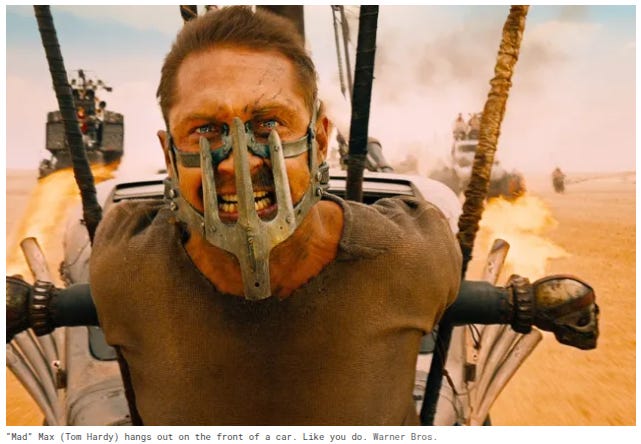
Life will get grimmer and hotter and rainier and more ecologically depleted and, frankly, more dangerous, but we won’t see a full Mad Max style “collapse” for some time.
And that means that we HAVE TIME to prepare. We HAVE TIME to build community locally, to collaborate on our “units of survival,” and make plans for the worst. We have time to pull together: to move if we have to, to grow crops or raise chickens, to stockpile beans and seeds, and do whatever might help cushion the blow for a lot of people in the near term.
Even if you believe that the near term is all we have, isn’t it worth doing everything possible to make the time that remains us less wretched and hungry and painful?
We also have time to stand up and demand action from our governments, which are after all still intact, still functioning, and still replete with money that could be leveraged to save lives rather than line the politicians’ pockets and make more wars.
We have time to go out on national strike. We have time to organise rolling work stoppages. We have time to elect leaders who will make actual changes, not just promise green hopium and nibble around the edges of the problem.
We have time to pull down the fossil fuel economy and replace it with something sustainable. We have time to attempt a controlled implosion of the extractive capitalist system, rather than wait, paralysed, until collapse occurs with no intervention and it all rains down on us like Vesuvius pulverising Pompeii.
If one million people showed up on the National Mall this November we could stop Washington DC dead in its tracks. We could make demands. We could force change. We could call for accountability, and accept nothing less.
But we have to do this TOGETHER. All of us - those who aren’t acting because they still have hope, and those who aren’t acting because they have none. And we have to do it, more or less, NOW.
The “what, me worry” folks aren’t going to join us.
But the people in the other two groups are a clear majority of citizens - not just in America, but worldwide. There are enough people who know that the climate is changing, know what the broad strokes outcomes will be, and should be incentived to take one last ditch stand against the grifters and tax cheats and lobbyist controlled dark money layabouts in the “halls of power.”
Reaching out to both groups to form a coalition of action is the only course of action that will get us anywhere. And that will be a heavy lift.
Together, we collectively bear responsibility for voting the current set of do-nothing scoundrels into office. We gave their power to them, and I think it is fair to say that we all expected more.
Group 2 probably expected to see emissions go down because of all that green new economy jazz. It is demonstrably clear that that outcome did not happen. Emissions are rising. France and Spain are burning down. Group 2 should be easy to motivate to revolt now because they feel cheated, abandoned, and lied to. I know I feel that way.
Group 3 have the power of realism on their side. They can SEE the harms coming our way. They are terrified. But they may have lost focus on the handful of decades left before the dystopian “end” that they presume is inevitable.
That handful of decades is key to an end that preserves what we can and that spares as many of us as possible. If we act, we can leverage humanity’s powers of care, collectivism, and compassion to fight for a dignified exit, not one where people are brutalized by panic, mayhem, and raw throated violence.
No one lives forever. But that’s no reason to abandon people to their fate if we have any other options.
We can use the coming handful of decades in personal preparation, and in building resilient local communities.
We can also use the time to crash the system that got us here, and to do it in a way that, as far as possible, serves the greater good.
There is another group “realists” who, like doomers are well informed and active, but who are trying to save what can be saved. We are trying to localize food production and inform the community about threats and coping mechanisms. We aren’t giving up.
The system is already collapsing and the warming is irreversible and accelerating, with enough already baked into the system to ensure mass starvation before the end (or possibly the middle) of the century.
We need to adopt a palliative care mindset and practice radical prefiguration, with mutual aid built up and communities strengthened from the grassroots. Relying on top-down power to save us is a fool's errand (IMO).
People always pull together in a crisis.